Saturday, July 07, 2007

Just take a look at Gerbrand...
Gerbrand volunteered with us in June, and as I write is still here on our NGO Volunteer Program.
I think he was quite amused and surprised to be voted The King of The Corn during the festival of St John - in all fairness to Gerbrand , he played along with it, and in fact did a magnificent job, too.
(Gerbrand is from Holland but is currently studying at the University of Wales in Cardiff....)
Some further information and a delicious sweetcorn recipe:
On 23rd June is the celebration of São João (St John The Baptist) the most popular saint in northeast Brazil. Fires are burnt in front of the houses, quadrilha is danced ( from French folklore) , all this is to give thanks for the good harvest, traditional meals are eaten and it is a great excuse to have fun...
Recipe for Canjica Pernambucana
Ingredients: · 25 spikes of sweetcorn· 1 cup of thick coconut milk· 4 litres of thin coconut milk· 3 cups of refined sugar· 1 soup spoon of butter· 1 soup spoon of salt· 1 cup of sweet herbal tea· 50 grames of butter cheese (optional – use a mincer if you have one)
Preparation and Method:
Grate the sweetcorn spikes and wash the mass with part of the light coconut milk through a thin sieve. Place mixture in a mincer machine or a liquidizer.
Add the rest of the thin coconut milk and boil it, always stirring it with a wooden spoon.After one hour and a half of boiling and stirring, put all the other ingredients and the remainder of the thick coconut milk.

Boil it on a low heat, always stirring it with the wooden spoon. Place it in a crosspiece plate or small plates and sprinkle with cinnamon…..
Hope you enjoy it!

PS: Thank you to, Mirian Machado-Thomas for writing about the June Festivals and providing the recipe for the delicious canjica...Obrigado Mirian...

If you have a question about the June Festivals or would like more Brazilian recipes , you may contact Mirian here
See you soon...

Sunday, June 10, 2007


Missing Children

Can you imagine what it must feel like to find your child has gone, been taken away from you , taken from their bed, has failed to return from an errand – has just simply disappeared...

Think about it for just one moment – and one moment only, because if like me, you find it unbearably hard to imagine – be thankful, very thankful…

But somewhere in the world this nightmare happens each and every day, in fact thousands of times per day – very thankfully some of these disappearances are accounted for very, very quickly, but sadly not all.

Missing Children Myth

According to the organization; connect for kids, posting pictures of missing children is the single most important tool for locating children who are missing. Further, law enforcement agencies concur and many police forces throughout the world cite photographs of the missing are the vital link between the public and the eventual solving of the disappearance.

If you want more information on missing children in your country, go to http://www.missingkids.com/ , for Brazil only go to http://br.missingkids.com/

To conclude I want to highlight the disappearance of Madeleine McCann. The disappearance of Madeleine has received extensive European news coverage. Indeed most countries outside Europe has to a lesser or greater degree given Madeleine’s disappearance some coverage.

Madeleine went missing on 3rd May, she was taken from her bed by a person or persons unknown in the Portuguese holiday resort of Praia de Luz in the Algarve. Madeline was holidaying with her mum and dad, and twin brother and sister.

Madeleine McCann is only 4 years old, and somebody, somewhere, has knowledge of her whereabouts.

If YOU know where Madeleine is, if you know anything at all about her disappearance , please. Please , please get in touch with your local police immediately. Alternatively you can call the Portuguese police on 00351 282 405 400 or Crimestoppers on 0800 555 111.

For more information please visit the official Madeleine McCann website, here: http://www.findmadeleine.com/

Lets hope Madeline is found safe and sound very soon…

Friday, May 18, 2007


Over 2 million children are forced into sex slavery each year.

If you think you can’t make a difference, think again...
My name is Kiren, I am volunteering with Volunteer Brazil in June of this year (2007). For 5 weeks I will be volunteering on the women at risk program in Recife.
As a Master’s Degree student in psychology at New York University, I have earned the opportunity to help the victims of sexual trafficking in Recife, Brazil with Casa de Passagen (House of Passage) for five weeks starting June 2007. Brazil is among the top three countries with the highest number of sex trafficking victims (some as young as six years old). UNICEF estimates that the number exceeds 500,000.

Casa de Passagen is a project based in Brazil that works with the city council, local authority, police, courts, judges, and other social service agencies to assist street prostitutes and sex slaves. Casa de Passagen rescues, rehabilitates, and empowers these women and children through shelters, counseling, education, various types of therapy, job skills and training, and recreational activities.

I am currently the on-site counselor for ECPAT-USA (End Child Prostitution, Child Pornography, and Trafficking of Children for Sexual Purposes), running a program that gives young adults an opportunity to educate, raise awareness, and develop and implement projects that address this increasing problem. I also have relevant counseling experience, especially working with diverse communities. I hope to use my education, skills, and experience to support these victims in starting a new life. In addition to the psychological services I can provide, my passion for raising awareness about the horrors of prostitution and trafficking will enable me to educate others throughout Brazil.

All programs are run solely on volunteer contributions, and therefore each program has a fee. To be able to participate in this program, I need financial assistance, which I hope you can help provide. If possible, I am asking to be sponsored for at least one day of my program ($111.11). However, any donation that you can contribute would be greatly appreciated. Checks can be sent to the address below.

I encourage you to visit http://www.volunteerbrazil.com/ to learn more about the program.

I thank you in advance and I look forward to sharing this experience with you. Kiren Shingadia.
Help me Fundraise!

Contact me:
email: Attention of Kiren: information@volunteerbrazil.com

Monday, April 23, 2007


With a Little Help From my Friends
My name is Lacey, I am Canadian and volunteering with Volunteer Brazil in July of this year (2007).
For 5 weeks I will be volunteering at an orphanage in Recife.

I was born and raised in Thunder Bay, Ontario. Although I have grown up in Thunder Bay, I have spent a number of months overseas on school exchange, as well as personal travel throughout North America. It is not vacationing which I love so much as traveling to experience different cultures and languages. Having recently graduated from Lakehead University's Teacher's College and wanting to experience more of the world, I havedecided to embark on a volunteer adventure in Brazil.
I have been very fortunate with the life I've had here in Thunder Bay, and I want to give back to those children who have not had the privileges I have had. During my time at the orphanage I will be helping in the everyday lives of the children.
I will be providing them with love and attention, playing games and helping them get ready for school, complete homework, and teach them informal english lessons. I want to have the opportunity to share some things with the children/youth of Brazil, while at the same time have them teach me something about their diverse culture. I had no doubt that this is what I wanted to do once I completed school, and by helping meraise funds you can help me reach my goal. In total my 5 week volunteer placement will cost me approximately CAD $3000.00.
This is broken down into program fee (which includes language training and living expenses for the duration of the 5 weeks), flight, visa, as well as traveler's insurance. My goal is to raise as much of that as possible. I will be approaching friends, family, and local businesses in search of any type of support. I am asking for funds; however, I will also be accepting services and donations which may help in my fundraising goals.
I am in the process of setting up a number of fundraising projects which will soon be posted on this site.
Thank you for your support!
Fundraising Events:

Yard Sale @ Evangel Church (Thunder Bay) on Saturday 5th May...

Car Wash @ Jones and Associates (Thunder Bay), day and time to be arranged...

BBQ, location, day and time to be arranged...

Ongoing fundraisers:
Mom's Pantry sales (please contact me for more information on how to order)Flower Pens ($3-on sale throughout the community)

Thank you to my sponsors...

Cozy Corner Store.
Jones and Associates Insurance.

Contact me: Lacey Dagenaisemail: lacey@volunteerbrazil.com

Sunday, February 04, 2007


LIKE A VIRGIN...
I doubt if these guys are being ¨touched for the very first time¨
Today marks the first day of many days of debauchery in Olinda.

Mothers, wives and girlfriends send their sons , husbands and lovers to do battle in this UNESCO World Heritage Town.
Bidding farewell to their men is not the usual anxious, heartwrenching wonderment and hope filled goodbye associated with battle - Indeed , mothers, partners and sisters have helped considerably with the battledress of short skirt, lipstick, stuffed brassiere and nail polish...
Freudian fear dictates that the females do not worry whether their men come back alive and victorious, but whether they come back as, well, er....men...
Like most Latin American males, Brazilian men are essentially macho, and prima facie, there are only 3 phrases or verbal attacks which can send a Brazilian man into a frenzy...
1) Telling him that he is a ¨corno ¨... (corno, means horn, signifying that he has grown horns, meaning that his wife or girlfriend is having an affair).
2) Calling his mother a prostitute...
3) Calling him gay... (meaning homosexual)...
It is with amusement then, this weekend, we will see thousands of Brazilian macho men, cross-dessed, flaunting themselves as desirable, delectable, female virgins...
Apparently, Dia das Virgens, or Day of the Virgins came about by a group of men from a Bairro Novo family (a district of Olinda). They decided it would be great fun to become, transvestite, for a day...(no surprise that the virgins wiggle their bits the 2 weekends before Carnival).
This tradition caught on very, very quickly and is now a major and significant event in the Olinda calendar...
Flaunt your bits at Olinda this year, only a few places remaining for our main carnival event...
Have a great weekend, whatever your doing...
Alan (or is that Alana)...

Saturday, January 20, 2007


AS MAD
AS A MARCH HARE
No beating around the bush, no spiel, no sales-talk...

EXCEPTIONAL LOW COST VOLUNTEER PROGRAMS...FOR MARCH 2007

1 WEEK VOLUNTEER PROGRAM FOR $550 US DOLLARS (280 Great Britain Pounds 430 Euros)

2 WEEK VOLUNTEER PROGRAM FOR $715 US DOLLARS (362 Great Britain Pounds 552 Euros)

3 WEEK VOLUNTEER PROGRAM FOR $880 US DOLLARS (445 Great Britain Pounds 680 Euros)

4 WEEK VOLUNTEER PROGRAM FOR $1100 US DOLLARS (558 Great Britain Pounds 850 Euros)

The only condition(s) which apply to our MAD MARCH HARE OFFER are as follows:

1) Your volunteer program must be 1,2,3 or 4 weeks in duration.
2) The first day of your program must commence in March 2007.
3) We are capping the offer to 30 volunteer program places.
Go and check-it out! MAD MARCH HARE OFFER

Thursday, January 18, 2007


Study

English

in an

English

College.


If you want to study English, there is no better place to learn the language than in England itself - Quaint, fashionable, historic, with sprawling countryside and very appealing villages.

With towns and cities, boasting unrivalled architectural diversity, whereby, history and tradition meets modernity.

You will be based in Brighton, on the south coast of England, amid beautiful, sprawling Sussex countryside, and as a welcome bonus, your college is less then 50 minutes from London.

This is a wonderful opportunity to study English in the traditional home of the language - Living, studying and working amongst English native speakers, in their own cultural environment will be an invaluable aid in helping you to achieve your objectives.

Some important points about your English course:

You will be taught by professional teachers.
Class sizes are a maximum of 12 students.
All students are over 16 years old.
Your teachers will offer counselling sessions, and ask about accommodation and your life in England.

The college has a self study centre to help you improve your English outside classes.
Academic and Administration staff will help you apply for a university place - and advise you.
Regency College is acreddited by The British Council.
In addition to your chosen Cambridge English examination qualification (or other) Regency College will present you with a certificate at the end of your course.

Your Accommodation

Your accommodation is going to be an integral part of your English cultural experience, with this in mind, you have a wide-ranging choice of accommodation options.

For more information, check out this page: http://unitedkingdom.volunteerbrazil.com/

Or, contact us directly, here:
http://unitedkingdom.volunteerbrazil.com/studyinenglandapp.html

GOOGLE BOT MAKES FALSE ARREST!


Hi,
Haven't been able to post for a week or so...
My blog was placed under house arrest by the google bot...

The blogger team sent me an email - here it is:

Dear Blogger user,
This is a message from the Blogger Team. In order to maintain a free, high qualityservice, we use an automated classifier to identify spam blogs.
[1]This system has detected that your blog has characteristics that resemble spam.Since you're an actual person reading this, your blog is probably not a spam blog.Automated spam detection is inherently fuzzy, and we sincerely apologize for thiserroneous result.
You won't be able to publish posts to your blog until we review your site and verifythat it is not a spam blog. To request a review, please fill out the form foundhere: http://www.blogger.com/unlock-blog.g?blogID=22981200
We'll take a look at your blog and unlock it in less than four business days. Pleasenote, if we don't hear from you, we will remove your blog within 20 days.
If the blog at http://volunteerbraziltravel.blogspot.com/ does not belong to you,then no action is necessary on your part. Any other blogs you may have will not beaffected. By using automated classification systems we've been able to dedicate more storage,bandwidth, and engineering resources to users like you instead of spammers.
Thanksfor your understanding.Sincerely, The Blogger Team
Fortunately, the humans at Google, have now recognised, and acknowledged the megalomaniac tendencies of their ¨virtual bouncers¨...
The human sent me this:
Hello,
Your blog has been reviewed, verified, and cleared for regular use so thatit will no longer appear as potential spam.
If you sign out of Blogger andsign back in again, you should be able to post as normal. Thanks for yourpatience, and we apologize for any inconvenience this has caused.
Sincerely,The Blogger Team
See you soon, Tchau ....
Check-out my new Brazil Travel Board - here:

Friday, January 05, 2007


New Project in The Amazon Rainforest.

Our Amazon project is deep in the western section of the rainforest, in the state of Acre.

Acre has the Bolivian border to the south, and the Peruvian border to the west.


Due to illegal logging and other devastating activities, 45% of the rainforest in Acre is protected by the Brazilian government, and the remaining 55% is very, very, closely monitored.

There are hundreds of plants, fauna and trees under threat of extinction, perhaps none more so than the Mogno tree, which, primarily, over the past 150 years has been illegally cut down and sold as the sought after, wood; mahogany.

The Mahogany was a much sought after commodity, particularly in the British and North American markets. It was ultimately this desire for mahogany, the once favored wood for furniture making (amongst many other traditions) which today threatens the species.

Our project then is to replant and protect the most endangered trees, plants and rainforest fauna. We do this by collecting seeds and fruits from endangered species, and replanting them in a nursery environment. The nursery stage is usually about 3 months in duration, after which the plants and seedlings are replanted in the Amazon Rainforest.

The project objective is to replant some 50,000 hectares per year, we are currently only managing 2000 hectares per year - less than 5% of target..……This is why volunteers are needed


More Information about your location.

Acre, lies in The Amazon Basin, and 93% of the state territory is covered with tropical rainforest. And despite the deforestation , Brazil, remains the most bio-diverse country on the planet (Indonesia is second).

Some of the trees are gigantic, such as the "sumauma" which can attain a height of 160 feet, or the water lily, named by a British Victorian explorer as "victoria regia" on account of the lily being ¨fit for a queen¨, spanning more than 6 feet across.

There are Brazil-nuts , copious amounts of exotic fruits, innumerable species of insect, birds of paradise, parrots, marine life, snakes, turtles, monkeys, jaguars, panthers and possibly other species waiting to be discovered.

Indigenous peoples of your location.

The known Indian peoples of the Amazon Basin, are divided into 6 linguistic groups:

Tupi, Karib, Tukano, Jê, Pano and Aruaque. However, there are also isolated groups who have little no contact with other groups. Notwithstanding, previously unknown indigenous Indian groups are sometimes discovered.

The first immigrants to the area

By the end of the 19th century the first wave of immigration took place, this was due primarily, to the European and North-American demand for rubber.

Rubber companies were set-up, called "Seringalistas" . The "Seringalistas" appropriated large areas of rain forest for rubber extraction (latex). The Amazon Indians tried in vain to resist, but their bow and arrows were no match for the guns of the rubber companies sponsored gunmen. The gun wielding "Correrias" were mostly bachelors, and usually killed only the male Indian, and taking the Indian women as wives. In addition to this , many of the Indians died from diseases such as tuberculosis and measles, hitherto unknown in the region.

The Indians were forced into labour, constructing roads and rubber-tapping.

The rubber boom brought great wealth to the Amazon cities of Belem and Manaus. However, this was to end, under dramatic and infamous circumstances.

Biopiracy is not new to Brazil, indeed the Portuguese colonizers were the first biopirates to set foot on Brazilian soil. However, the decline of the Brazilian rubber industry is infamously attributed to an Englishman; Henry Alexander Wickham, who in 1876 stole rubber tree seeds.

He was originally in negotiation with the Brazilian government to establish a rubber industry in the Amazon region. When the parties could not agree terms, Wickham hid the rubber seeds on his ship, stashed between banana leaves.

Ironically , Brazilian officials organized a farewell party for Wickham, and proceeded to give him a most generous send-off, not knowing of course, that he had hidden seeds on board his ship.

Wickham and his pirates sailed for the British colonies of Ceylon (Sri Lanka) and Malaysia and established the region as the worlds main latex production and exporters. Which devastated the Brazilian rubber-tapping industry.

Wickham was subsequently knighted by King George V, and loathed by Brazils rubber barons, who called him ¨the executioner of the Amazonas¨.


If you would like to volunteer on our Amazon Project, please contact us by either , clicking here:

http://volunteerbrazil.com/booknow.html

or by emailing us: alan@volunteerbrazil.com , mention, Wickham the rubber-tree pirate in your email, for 15% discount off the program cost.

Sunday, December 24, 2006


Christmas in Brazil...


In the main , Christmas in Brazil, follows the European traditions - particularly, those of Portugal.

It is essentially a time when families get together, most notably for Christmas supper, which is eaten at Midnight on December 24th (although, lots of families eat earlier than this - but most notably on Christmas Eve, as opposed to Christmas Day.

The Christmas Supper will consist of turkey, chicken, pork, ham, rice, fresh vegetables and fruit dishes. However, poorer Brazilians, usually have to make-do with rice and chicken.

Traditional Catholic families may attend; Mass at Midnight (on the 24th), the Mass ends at 1.00am, and is known as The Rooster Mass or; Missa do Galo.


TRADITIONS OF CHRISTMAS


One of the main traditions is the nativity scene or; Presépio The Presépio was introduced in the 17th century by a Franciscan friar named; Gaspar de Santo Agostinho. Most interestingly, he was from Olinda, which is also considered the birthplace of Brazilian nationality.

Father Christmas, or; Papai Noel is the unsuprisingly, traditional gift bringer, originally hailing from Greenland (according to legend), notwithstanding ,the Papai Noel concept came to Brazil during the 1950s, originating from The United States, - and subsequently commercialised in the 60s and 70s.


The decorated Christmas tree is an important Christmas ingredient, as are coloured , flashing electric lights, both adorn the main living room of houses and apartments, with the flashing lights, particularly popular draped across and over balconies of the many millions of apartment buildings.

Fireworks can be heard all hours of the day and night (mostly at night - and sometimes all through the night), and this typically Brazilian, pyrotechnic dimension to festivities, will continue until January 6th, otherwise known as Three Kings Day, which symbolizes the Three Wise Men , taking gifts to The Baby Jesus.


Happy Holidays...May you find joy, peace and contentment, and I sincerely hope that 2007 will be a memorable, and very special year, for you!


Take care, Alan Thomas.

Wednesday, December 20, 2006

Take A Walk On The Wildside...

Have you ever wanted to go to the Amazon Rainforest?

We are launching 2 wonderful opportunities for 2007...

Take A Walk On The Wildside 1
............................................................


Would you like to help us with reforestation in The Amazon? This is a great opportunity to help breathe new life into the ¨lungs of the world¨.

Come and help us replant some of the rare and most vital trees and plants in the Amazon.

Interested? Please drop us an email - to: alan@volunteerbrazil.com , mention, Walk On The Wildside 1, and we will give you 15% discount, off your program cost.


Take A Walk On The Wildside 2
....................................................


Deep in The Amazon ,we have an environmental art project, whereby, children and Amazon natives make the most beautiful art from their environment. Using natural materials which fall from the jungles plants and trees, materials taken from the Amazon River and the forest floor...

Interested? Please drop us an email - to: alan@volunteerbrazil.com , mention, Walk On The Wildside 2, and we will give you 15% discount, off your program cost.

Monday, December 18, 2006


Portuguese,
in Brazil.

If you are considering coming to Brazil, be it as a tourist, for business purposes, backpacking or on an organised volunteering or cultural exchange program, you will need to learn some Portuguese...
WE CAN HELP YOU!
Our Portuguese Courses in Brazil have been prepared and are delivered by qualified Professional Educators.
We have 3 Portuguese Courses to choose from...
Portuguese Course 1 (Starter)

This course is ideal for beginners and will help you survive in everday situations.
Our Portuguese Course uses a very much eclectic approach. Our objective is to give you the confidence and competence to develop your basic, oral Portuguese in a variety of situations.

Portuguese Course 2 (Intermediate)

Our second Portuguese course logically follows on from the first course. If you have existing Portuguese language skills, or have already taken Course 1 - then this is the course for you!

Our objective is to enable and empower you to express yourself in Portuguese, in more sophisticated ways, addresing a variety of circumstances.

Our Intermediate Portuguese Course is again geared towards everyday, practical usage. However, there is more attention to grammar this time.

Portuguese Course 3 (Advanced)

Our Advanced Portuguese course logically follows on from the Starter and Intermediate Courses.

Our objective is to enable you to express yourself in Portuguese, both orally and in writing.

Our Advanced Portuguese Course is again geared towards everyday, practical usage. However, there is more attention to grammar, written form, and being able to partake in conversation.
Are you up for it?

Only US$300 (175 GBP) Per Course


Whats Included:
7 nights accommodation with a Brazilian family either in Recife or Olinda
4 hours of Portuguese classes each day
20 hours of Language
Tour of Olinda or Recife
Shopping Trip
2 meals per day
Airport pick-up
Course materials
CONTACT US TODAY:
0055 81 32692793(Office)
Mention Language Course Blog for 15% Discount.

Saturday, December 16, 2006

BRAZILIAN

CARNAVAL

2007

OLINDA...


Olinda is considered to be the birthblace of Brazilian nationality, mother of the Republic! In 1537 Duarte Coelho Pereira who had been granted the Pernambuco Captaincy declared from the top of the hill.

"Oh linda situação para uma Vila" What a beautiful place to build a city.

This is the fabled origin of the city name Olinda.During the XVI Century Olinda was the most prosperous city in Brazil, entirely through the plantations of ¨white gold¨ (sugar).

Olinda has many, many delights for the visitor, and a particular mention has to be given to the Olinda Carnaval. Of course Brazil is world renowned for its annual Carnaval events.


Most of the worlds media are guilty of displaying the fabulous images of Carnaval in Rio de Janeiro and its resident samba schools. But when Brazilians want to party, when they want to experience an authentic carnaval , they come to Olinda and Recife. It takes a whole year for Brazilians to prepare for Carnaval, and the Olinda and Recife versions is certainly worth waiting for....

Nothing more expresses the spirit of Olinda than going up and down the hills of the Cidade Alta. Walking along its narrow streets, visitors can see the traditional churches and old houses that characterize the city. Brazil’s first School of Law was founded in Olinda, as well as several monasteries, convents and schools.

Lying only six kilometers from Recife, Olinda is home to innumerable artists, the builders of Olinda today, considered by Unesco as Historical and Cultural Heritage of Mankind. Among the artists that have chosen the city as home are many musicians, who enliven Olinda during Carnival, when the City already known for its intellectuals, historians and painters, also becomes the Olinda of clowns, pierrots and masquerades.

COME AND JOIN THE PARTY -

CONTACT US:
TEL: 0055 81 32692793 (office)
(mobile) 0055 81 88798877
information@volunteerbrazil.com (e-mail)
http://www.volunteerbrazil.com/ (website)

Thursday, December 14, 2006


BRAZIL

CARNAVAL

2007

Come and join us for the Worlds Greatest Party...
From Only US$500 / £250


The world famous Carnival of Olinda, in Brazil, is considered to be the most authentic, the most beautiful, and the most spontaneous of its kind.

And considering that over 1 million people take to the streets each day in this UNESCO World Heritage Town, it remains an amazing fact that the WORLDS GREATEST STREET CARNAVAL is not yet comercialised.

Olinda and Recife have many, many delights for the visitor, but the Olinda and Recife Carnavals deserve a very special mention. Of course Brazil is world renowned for its annual Carnaval events, but when Brazilians want to party, when they want to experience an authentic carnaval , they come to Olinda, and Recife

.


Reserve Your Place FOR 2007

5 Nights - From 16th February to 20th February

(Carnaval Period is 16th - 20th February)

(Friday through Tuesday, you leave Wednesday morning)

Early Booking is Strongly Advised!

SEE YOU THERE!

CONTACT US:
TEL: 0055 81 32692793 (office)
(mobile) 0055 81 88798877

information@volunteerbrazil.com (e-mail)

Friday, September 08, 2006

PAID...

TEACHING ENGLISH OPPORTUNITY...

If you are intent on coming to Brazil, and are available from November 15th through December 23rd. We have 3 paid English Teaching positions available.

The Details


  • Teaching English on a residential immersion course in South Brazil.

  • Accomodation and food is included, you stay at a five-star hotel.

  • Return flghts to destination are included (we would prefer you to be already in Brazil - but will consider covering international flights for suitable candidates).

  • Compensation paid is 600 United States Dollars.

  • Male or female, preferred age, 18 to 32 years old.

If you are interested , please send me your CV: alan@volunteerbrazil.com, or call me...

Take Care, Kind regards, and have a great weekend...

Alan Thomas.

Volunteerbrazil.com,
Volunteer Programs and Cultural Exchange,
Rua Muniz Tavares – 81 – 602, Jaqueira, Recife,
Pernambuco, Brazil.

005581 32692793(office),
005581 99716843 (mobile)
005581 88034177(mobile).

www.volunteerbrazil.com (website)

Monday, August 21, 2006

SÃO PAULO

An Unique Opportunity to savour Sao Paulo from two perspectives...
Volunteering with Sao Paulo, orphans, is a challenging and rewarding experience - combine this with the fact that your volunteering program is based in the Worlds 2nd largest City (largest in the southern hemisphere) and you have an almost unique opportunity to experience and help with a project that few will ever embark upon.

Are You Up For This?

If you can give, love, support and positive direction to boys, girls and babies - from 1 week old to 17 years of age and spend time playing with them, getting them ready for school, helping to cook meals and snacks for them, help them with their homework and such like.

If you can act as a mentor, role - model and parent figure for these kids, most of whom have never known their natural parents then this project is for you! You will be based in a delightful location in Sao Paulo with other International volunteers and Brazilians who volunteer and work at the orphanage.

About 20 million people live in the Greater São Paulo metropolitan area.

The city and state of São Paulo are so economically relevant for the patterns of South America that they are considered a separate region of Brazil when international competitiveness rankings are formulated. Concerts, plays, film festivals, fashion shows, and international sports events, São Paulo disputes, with Rio de Janeiro the title of Brazil's capital of culture and sports.

Ros, from Dublin, looks like she maybe Dancing in the Street...

Sao Paulo Information

Sao Paulo has an almost unique ethnic diversity, not found anywhere else in the World.

São Paulo is famous for its varied and sophisticated gastronomy, ranging from Chinese to French, from fast food chains to five star restaurants. Its night life is animated by thousands of bars, pubs, lounges, and discos which cater for a variety of music tastes and many are open all night.

For More Information On This Unique Opportunity For Volunteer Travel, Visit Volunteerbrazil.com

This Specific Opportunity is ; here VOLUNTEER IN SAO PAULO

Sunday, June 11, 2006


SAMBA, SAMBA, and more SAMBA...


Samba, The Classical, National Style of Brazil

Samba is one of the most popular forms of music in Brazil. It is widely viewed as Brazil's national musical style. The name semba most probably comes from the Afro Brazilian “lundu”( XVIII century), also known as umbigada or batuque: a mixture of African rhythym brought from the slaves of Angola who lived in Bahia state.

When the slaves were transferred to Vale do Paraíba (XIX century) to work on the coffee plantations, they brought the semba with them. Later they moved to the National Capital – Rio de Janeiro with the abolition of slavery where semba gained its own identity. Living at the cariocas districts of Gamboa and Saúde they introduced the African rhythym semba to the Royalty. It used to be danced in the houses of Bahia’s black ladies like Amélia, Ciata and Prisciliana.This rhythym soon developed into what we know today as Samba, mixing with polca, maxixe and xote.

The title "samba school" ("escola de samba") originates from samba's formative years. The term was adopted by larger groups of samba performers in an attempt to lend acceptance of samba and its performance; local campuses were often the practice/performance grounds for these musicians and "escola" gave early performers a sense of legitimacy and organization to offset samba's somewhat controversial social atmosphere.

"Pelo Telefone" (1917), by Donga (Ernesto dos Santos) and Mauro Almeida, is generally considered the first samba recording. Its great success carried the new genre outside the black ghettos. Who created the music is uncertain, but it was most probably the work of the group around Tia Ciata, among them Pixinguinha, João da Baiana, Mauro de Almeida e Sinhô (José Barbosa da Silva- knew as the King of Samba). This song was really created in a “roda de partido alto” by a group of high quality samba composers.

After the recording Samba would conquer the phonographic market and with the inauguration of the radio in 1922 the music would reach the media class in Rio.The new style brought the talents of media class composers like the medical student Noel Rosa and the law student Ari Barroso Ari Barroso is famous for composing ''Tarzan, the son of the taylor '' and ''Aquarela do Brasil''.

With the radio other talented people like Francisco Alves, Orlando Silva and Carmen Miranda became great samba idols in Brazil.


In 1929, a group of musicians led by Ismael Silva founded the first Samba School, Deixa Falar, in the neighborhood of Estácio de Sá. They transformed the musical genre to make it better fit the carnival parade. In this decade, the radio spread the genre's popularity all around the country, and with the support of the nationalist dictatorship of Getúlio Vargas, samba became Brazil’s "official music".


In the following years, samba has developed in several directions, from the gentle samba-canção to the drum orchestras which make the soundtrack of carnival parade. One of these new styles was the bossa nova, made by middle class white people. It got increasingly popular over time, with the works of João Gilberto and Antônio Carlos Jobim. In the sixties, Brazil was politically divided, and the leftist musicians of bossa nova started to gather attention to the music made in the favelas. Many popular artists were discovered at this time. Names like Cartola, Nelson Cavaquinho, Zé Keti and Clementina de Jesus recorded their first albums.

In the seventies, the samba got back to the radio waves. Composers and singers like Martinho da Vila, Clara Nunes and Beth Carvalho dominated the hit parade.
In the beginning of the eighties, after having been sent underground due to styles like disco and Brazilian rock, Samba reappeared in the media with a musical movement created in the suburbs of Rio de Janeiro. It was the pagode, a renewed samba, with new instruments, like the banjo and the tantan, and a new language, more popular, filled with slang. The most popular names were Zeca Pagodinho, Almir Guineto, Grupo Fundo de Quintal, Jorge Aragão, and Jovelina Pérola Negra.

Their typical instruments are: repinique, caixa, surdo, chocalho, agogô, pandeiro.

Nowadays, samba is still one of the most popular musical genres in Brazil.

Thank you to Mirian Thomas, who helped with this article on Samba.

If you are interested in learning about, and volunteering on a Music Project in Brazil - please check-out the following link: Music Education In Brazil

Sunday, May 28, 2006


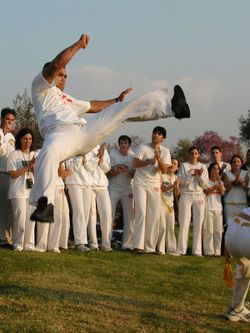
Capoeira , Dancing For Defense…

During the Portuguese colonization of Brazil , more that two million Africans were brought to the territory as slaves.

In the main they were taken to what are now the states of Pernambuco, Bahia and Rio de Janeiro. It is thought that the slaves from Angola, were the first to bring Capoeira to Brazil in the 16th century.

Capoeira was initially developed as a self-defense technique based on traditional African dance rituals. The slaves practiced during their free-time and in their living quarters , away from the prying eyes of the landowner master (often a sugar plantation).

Whilst doing this the slaves were training their body and mind for combat situations. And as any martial art was strictly forbidden, they ingeniously cloaked their training , making it look like an innocent looking recreational dance.


Capoeira was further perfected by slaves who had escaped, escaped slaves founded a number of quilombos, which were hidden slave-governed territories. The first of which is believed to have been in 1850 , in Serra da Barriga.


During the Dutch invasion (1628-Fernando de Noronha), of Pernambuco, consisting of 37 ships and 3000 soldiers. The Portuguese gave freedom to slaves in order to help them fight against the Dutch’s invaders.

Not surprisingly, many of them absconded and settled in Palmares (south from Recife) they established the Quilombo of Palmares. They declared a free African nation with a government similar to their ancestral homes in Africa. The largest colony was governed by Princess Aqualtume (daughter of the King of Congo) and was succeeded by her son, King Kanga Zumba then his nephew Zumbi.

They fought a decade-long war against their colonial oppressors, but Zumbi was eventually captured.

On 20th of November 1695, he was captured and killed by Domingos Jorge Velho a bandeirante from São Paulo who was assisted by Bernardo Vieira de Mello (with the troops of Olinda) and
Sebastião Dias along with other troops, sent by Souto Maior the governor of Pernambuco (1686).


He was decapitated and his head was taken to Recife to be exposed in a public square to serve as an example to other slaves.


Capoeira was used not only in direct combat, it also inspired the battle strategy itself; feigning retreat, thus luring the over-confident enemy into remote territories only to strike back at an unsuspecting place and time.

The slaves also introduced the African religious music and dance to the Capoeira making it less suspicious.

Prohibition of Capoeira remained even after slavery was abolished in 1888. It was nevertheless practiced by the poorer population on public holidays, during work-free hours and similar occasions. Riots, caused by police interference, were common. By the 1920s, persecution and punishment were almost successful in eradicating Capoeira from the "streets" of Brazil.
In spite of the ban, Master Bimba and Master Pastinha founded the first Capoeira schools in Salvador, Bahia. Master Bimba created a new style, the "Capoeira Regional" (as opposed to the traditional "Capoeira Angola" held by Master Pastinha) .

Essentially it was by incorporating new moves and techniques which helped Master Bimba convine the authorities of the cultural value of Capoeira, thus ending the official ban in the 1930's.


Berimbau is the main instrument for Capoeira. It was brought to Brazil from Angola with the music of the slaves. It is made from a wood called biribá and has a small percussion instrument called caxixi (a big basket shaker).
Some of the most famous Capoeira movements are: armada, au, benção, macaco, martelo, meia-lua de compasso, queixada, rabo-de-arraia.

If you would like to learn more about capoeira or volunteer or intern in Brazil, please contact either Alan or Mirian: HERE

Friday, May 26, 2006

Don’t Miss The Forró Train

Pernambuco, in north-east Brazil is preparing for its most popular folklore festivals, which are traditionally celebrated in June.

The month of June signifies the preparation and celebration of some of Brazils most popular folklore festivals (especially Pernambuco) in honour of Roman Catholic saints and the sweetcorn harvest.

The12th of June, Dia dos Namorados (Valentine’s Day) is followed on the 13th by Saint Anthony’s Day.

Saint Anthony was Portuguese and is a very popular saint in Brazil. In actual fact he is the patron of all lovers. One intriguing custom is; if a girl wants to find a husband she makes a promise to Santo Antônio.

For instance, a young single woman may promise Saint Anthony that she will give bread to the poor, or even attend church each Sunday – in exchange for a husband…sounds a good deal to me,,,(yikes).

So, on Santo Antônio’s Day all girls are making “adivinhações” to guess or to predict who is going to be their husband.” At midnight the girls go to a banana tree with a ¨virgin¨ knife and lunge it into the banana trunk. The following morning the girl will make a bee-line for the tree, to hopefully discover the initials of her husband-to-be.

June also sees some traditional meals being prepared and eaten.

Typical food for the June Festivals are primarily made of sweetcorn, such as canjica, pamonha, bolo de milho and pé-de-moleque.


The party for the season is the popular “forró”. According to Câmara Cascudo , the most famous Brazilian expert in northeast folklore, forró came from”
forrobodó” which means “divertimento pagodeiro" fun popular party.

This type of party has typical northeast dances such as (forró, baião, coco, rojão, quadrilha, xaxado, xote).

Another version of origin, states that forró has its origins in the English denomination of; “for all” a party which was very common, and created by engineers of the Great Western Railway in Pernambuco and other states, to entertain employees during the weekends.

The Pernambuco accordion composer, Luiz Gonzaga do Nascimento creator of the rythym Baião (1912–1989) was the first person to record a disc called “Forró de Mané Vito” in 1949 in partnership with Zé Dantas.

The city of Caruaru in Pernambuco (considered the capital of forró) is famous for the best and biggest June parties, which attracts thousands of people from all over the world, during the Festivals of June. These are held at the Vila do Forró.

On 23rd June is the celebration of São João (St John The Baptist) the most popular saint in northeast Brazil. Fires are burnt in front of the houses, quadrilha is danced ( from French folklore) , all this is to give thanks for the good harvest, traditional meals are eaten and it is a great excuse to have fun too

On the 29th Saint Peter ends the June cycle of the most popular parties in the northeast of Brazil…….

Are you coming ? – don’t forget it is ¨for all¨ Forró………

Recipe for Canjica Pernambucana

Ingredients:
· 25 spikes of sweetcorn
· 1 cup of thick coconut milk
· 4 litres of thin coconut milk
· 3 cups of refined sugar
· 1 soup spoon of butter
· 1 soup spoon of salt
· 1 cup of sweet herbal tea
· 50 grames of butter cheese (optional – use a mincer if you have one)


Preparation and Method:


Grate the sweetcorn spikes and wash the mass with part of the light coconut milk through a thin sieve. Place mixture in a mincer machine or a liquidizer.


Add the rest of the thin coconut milk and boil it, always stirring it with a wooden spoon.
After one hour and a half of boiling and stirring, put all the other ingredients and the remainder of the thick coconut milk.

Boil it on a low heat, always stirring it with the wooden spoon.
Place it in a crosspiece plate or small plates and sprinkle with cinnamon…..


Hope you enjoy it!

PS: Thank you to, Mirian Machado-Thomas for writing about the June Festivals and providing the recipe for the delicious canjica...Obrigado Mirian...

If you have a question about the June Festivals or would like more Brazilian recipes , you may contact Mirian here